
Software for the parts off-the-shelf can't reach.
Custom internal tools, operator dashboards, multi-source admin software. Built when the spreadsheet has stopped scaling but the SaaS catalog doesn't have what you need.
Off-the-shelf SaaS is great for what it covers. The trouble starts when your operation needs five different tools, no two of which talk to each other, and you're the only person in the building who can read the daily picture by tabbing through them.
We build the screen that replaces the five tabs. Your data sources — Notion, Asana, QuickBooks, Plaid, Hostaway, AirDNA, or whatever you're running — pulled into one operator-facing dashboard. The home view is the alert feed: what's off, what's overdue, what needs your decision. Not a chart wall.
Reference build: the internal dashboard we shipped for an SD-based short-term rental management company running 60 properties across 13 states. Five tabs collapsed to one operator screen. Cron that auto-ratifies the prior month. Per-property P&L pulled live from QuickBooks Class with a Plaid cash bridge.
From the Divergent Estates operator dashboard (Sioux Falls, 2025-2026)
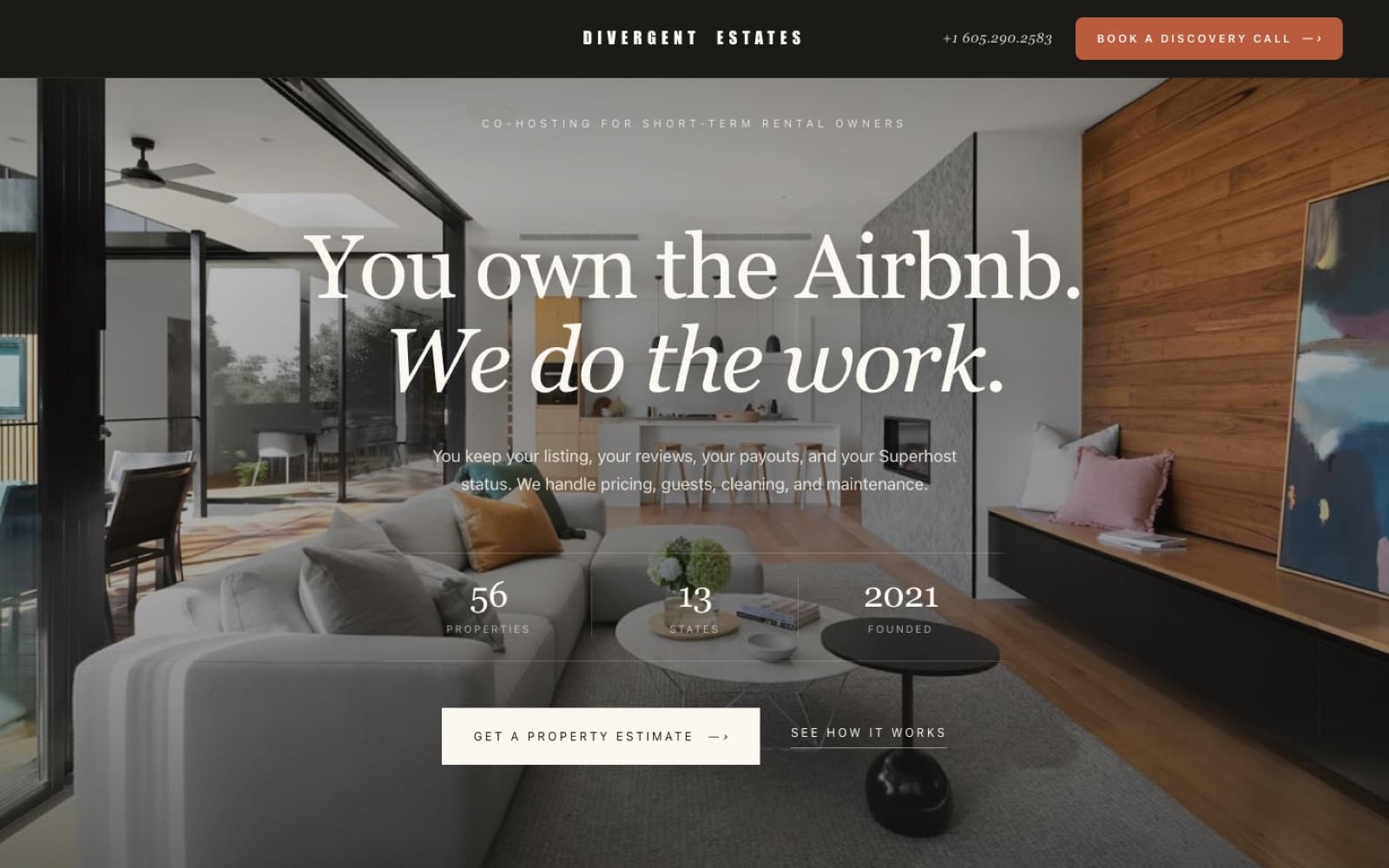
The reference custom-software build in our portfolio is the internal operator dashboard we built for Divergent Estates — a short-term rental management company running 60+ properties across 13 states. The dashboard pulls live data from Asana (operations workflow), Notion (records source-of-truth), QuickBooks (accrual P&L by property class), Plaid (bank-truth cash position), Hostaway (lodging bookings), and AirDNA (market comps). Five tabs collapsed to one operator screen. The hardest architectural decision was how to handle the QuickBooks → Plaid reconciliation — accrual GAAP at the property level, with a cash bridge for the daily picture. What we landed on: nightly cron that auto-ratifies the prior month, then a per-property delta feed that surfaces variance for the operator to review. Pattern transferred to other operators since: don't build software that asks for decisions; build software that surfaces the ones already overdue.
What a custom software engagement includes
- /01
Discovery scope
Week one: we map your existing tools, your daily decisions, and what an ideal operator screen looks like. Output is a fixed-fee scope document — no surprise billing.
- /02
Data integrations
Next.js backend pulling from your sources via their APIs. Asana, Notion, QuickBooks, Plaid, Hostaway, Stripe, Twilio — anything with a real API is in scope.
- /03
Operator dashboard
Mobile-friendly. Alert-feed home view. Per-property or per-unit pages. Filterable, searchable, fast.
- /04
Admin authentication + RBAC
Magic-link or password auth. Role-based access (owner, manager, staff). Single sign-on if you're running Google Workspace or similar.
- /05
Reports + exports
Monthly summaries, on-demand exports, scheduled email reports. CSV / PDF where it makes sense.
- /06
Documentation + handoff
Operator runbook. Admin training session. Code documented in the repo. The next developer (or the next us) can pick it up cleanly.
Pricing: Tier 3 · scope-based. Discovery is $1.5–3k depending on complexity; build is fixed-fee after the scope document is signed. See all tiers →
What real custom software projects look like
- Multi-property STR operator dashboard pulling Notion + QBO + Plaid + Hostaway
- Restaurant-group operations console (POS + reservations + payroll)
- Trades-business job-routing + customer-history portal
- Healthcare practice patient-flow dashboard (HIPAA-aware)
- Real estate brokerage agent-performance + commission tracker
What buyers ask about custom software
Will it integrate with my existing tools?
If your tools expose an API or have a Zapier connector, yes. Notion, Asana, QuickBooks, Plaid, Hostaway, Stripe, Twilio, HubSpot, Salesforce — all standard. Niche or legacy tools get evaluated in discovery.
What if my data is messy?
Most operators' data is messy when we start. The dashboard surfaces the messiness — which is often the first real win, because you can finally see it. Cleanup is iterative.
Who owns the data?
You do. The database, the code, the integrations — all in your accounts. We can host on Vercel + Supabase under your billing, or migrate to your existing infrastructure. Your call.
Need custom software?
Tell us the project in a paragraph. We reply within 24 hours with a plan, a timeline, and a real number.